How We do It
ARCC's Tūmanako - Table of Hope
model of Practice
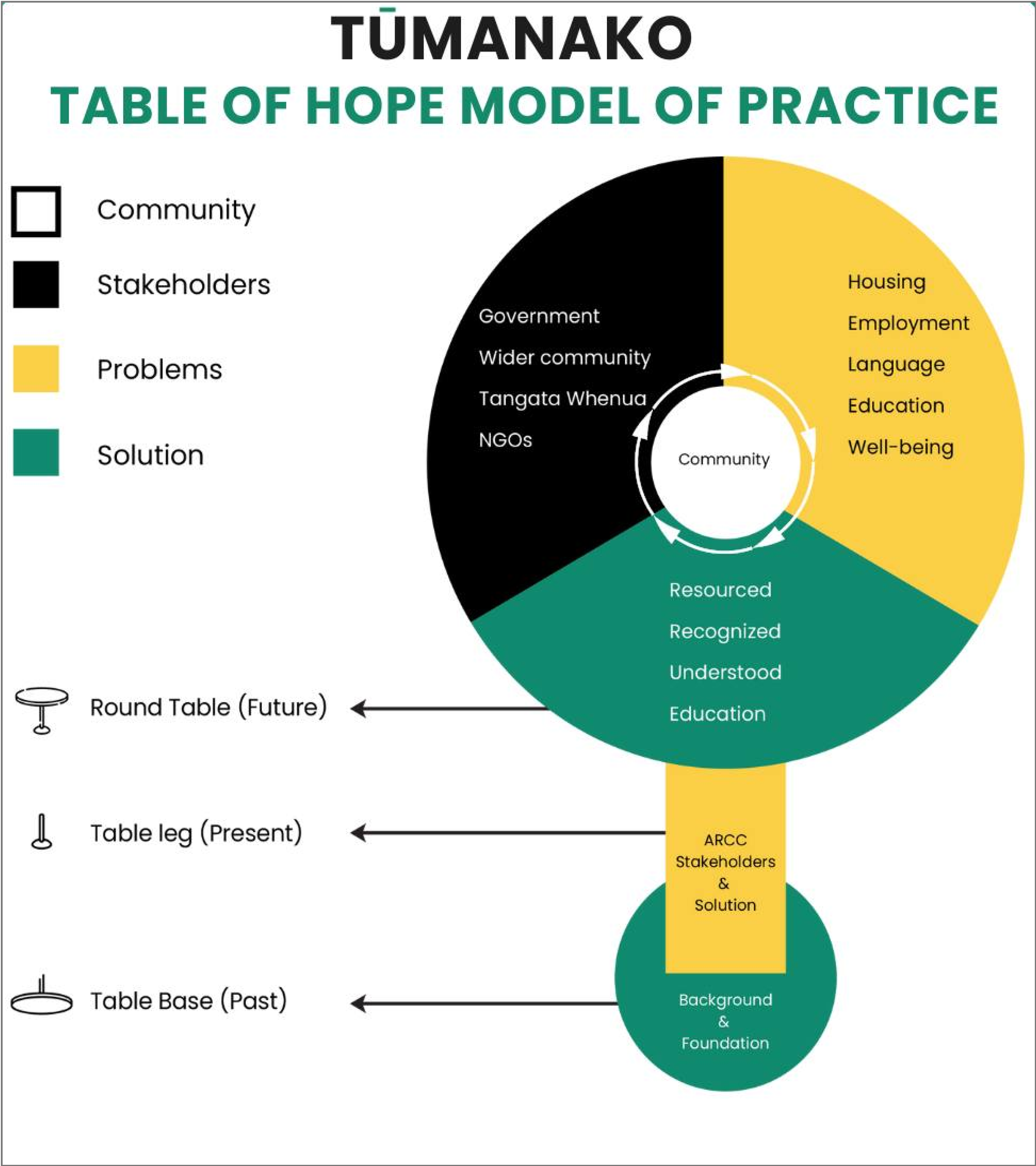
ARCC follows a model of engagement and practice founded on Tūmanako, meaning hope. ARCC hopes for a better future for our families and communities as new residents in Aotearoa New Zealand. We learn from our community in the “family voice method” delivered through a Conversation-Over-Meal approach, integral and familiar to our community’s traditional way of coming together.
Our Table of Hope model holds space for our community to share their challenges, which enables ARCC to understand and support their need for and obstacles to belonging. Recognising their identities, cultures, and contributions to Aotearoa is key to this approach.
The model was adopted by the Auckland Resettlement Sector Steering Group and launched at the Tūmanako Summit in June 2021. The summit aimed to create opportunities for resettled communities in Aotearoa. The Tūmanako – Table of Hope model has three parts: past, present, and future. The past includes resettled people’s backgrounds and origins. The present focuses on the resettlement and integration process in Aotearoa, involving community-led organisations and stakeholders. The future encompasses their aspirations and potential for better integration and belonging. Each part is essential for achieving hope and resilience for a better future.
The Tūmanako – Table of Hope guides ARCC’s work as an organisation, as individuals, and as a community. We advocate for its principles across the resettlement sector and Aotearoa society. The four key solutions identified by the resettled community—listening, understanding, recognising, and resourcing—are central to this model and our purpose. By following this model, we aim to achieve integrated and thriving resettled communities in Aotearoa. This requires collaboration from everyone in the resettlement sector.
Te Ara Tika Tangata
Human Rights Based Approach
At ARCC, a human rights-based approach is central to how we work. It guides us to empower community members to know and claim their rights while strengthening the capacity and accountability of individuals and institutions responsible for upholding them. This approach ensures that the voices of resettled immigrants are actively involved in decisions that affect their lives and that service providers understand how to respect, protect, and fulfil these rights. By embedding human rights principles into our policies, programs, and day-to-day operations, ARCC integrates these standards into every aspect of our work to create more inclusive, fair, and effective support for our communities.
Ā mātou tikanga
REAL Pillars
Aotearoa Resettled Community Coalition (ARCC) is a community organisation that supports immigrant communities, particularly those from forced migration backgrounds, to settle successfully and participate fully in life in Aotearoa New Zealand. ARCC provides integrated settlement support services through its four key pillars: Research, Education, Advocacy, and Leadership (REAL).
Research
Through Research, ARCC carries out community-led projects to understand the needs and experiences of resettled communities and to inform more effective programmes and policies. This work is delivered through key projects and publications that centre lived experience and community voice.
Education
Through Education, ARCC shares knowledge and builds capability by supporting communities to navigate systems and develop essential skills. This is delivered through training and workshops, social media, and community support services that provide accessible and practical learning opportunities.
Advocacy
Through Advocacy, ARCC works to amplify community voices and address systemic barriers. This includes delivering community support services, as well as organising events and campaigns that raise awareness and improve access to services and opportunities.
Leadership
Finally, through Leadership, ARCC strengthens community capacity by developing leaders and creating pathways for active participation. This is delivered through programmes, alongside stakeholder engagement and community outreach that empower individuals to contribute to their communities and wider New Zealand society.
REAL PRINCIPLES - Research, Education, Advocacy, Leadership
Core Elements of the REAL Principles Framework:
1. Problem Definition:
Thoroughly articulate the issue at hand by identifying root causes rather than merely addressing symptoms. This requires a comprehensive understanding of the context and complexities involved.
2. Data Collection and Analysis:
Engage in unbiased data gathering and interpretation to enhance our understanding of the situation. This step is crucial for informed decision-making and building a foundation for meaningful solutions.
3. Solution Generation:
Facilitate brainstorming sessions to generate potential solutions while considering the unique needs of vulnerable populations. Recognising their circumstances is essential to providing authentic support.
4. Consultation:
Involve stakeholders directly affected by the issues at hand. Collaborative engagement ensures that selected solutions are relevant and appropriate, fostering a sense of ownership among community members.
5. Implementation Planning
Develop a comprehensive strategy to implement the chosen solutions. This includes identifying potential obstacles and refining the approach through ongoing testing, feedback, and reflection.
Throughout this process, the REAL Principles guide our efforts to acquire new information, enhance our understanding of critical issues, and identify solutions to urgent challenges. We prioritise equipping ourselves with the necessary knowledge and skills while aligning with our personal values. We advocate for diverse educational pathways—formal, non-formal, and informal—as essential mechanisms for transformation.
In our commitment to serving and protecting community members, we actively amplify their voices, provide guidance, make recommendations, and empower them to influence decisions that drive positive change. We strive to lead with intention, fostering the capability to guide and inspire others. Through effective communication, shared vision, and mutual support, we work collectively to achieve common goals, reinforcing the resilience and agency of our communities.
Te Reo me ngā Kupu
Use of terminology and language
At ARCC, the language we use reflects our commitment to respect, empowerment, and the lived experiences of our communities. We acknowledge members as New Zealand immigrants while recognising their journeys of forced migration (former refugees), honouring both their achievements in resettlement and the challenges they have overcome. Using accurate and respectful terminology is more than a matter of words, it is part of ARCC’s approach to supporting healing, fostering pride, and strengthening a sense of belonging. We encourage members and staff to use this language consistently, reinforcing ARCC’s values of empathy, justice, and self-determination in all interactions and programs.